The Windows 10 OS by default hides the essentials files/folders (having hidden attribute enabled) that are not meant to be used by the common users. Usually, the hidden files are not viewable and to show them you have to change Windows 10 settings (hidden files and folders are a bit greyed out when seen in the File Explorer). To unhide the hidden folders/files in Windows 10, you may try the methods below:
How to Show Hidden Files Windows 10
Use File Explorer Options
- Click Windows , type: File Explorer Options , and then open it. Open File Explorer Options
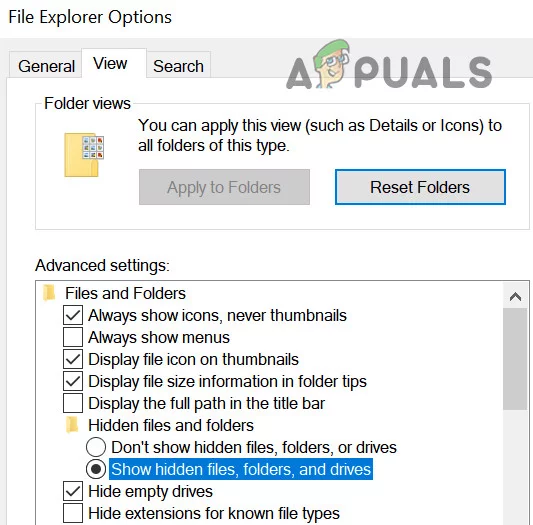
- Now head to the View tab and under Show Hidden Files and Folders , select the radio button of Show Hidden Files, Folders, and Drives . If you want to show the system files, uncheck the option of ‘ Hide Protected System Files ’. Show Hidden Files and Protected System Files
- Now apply your changes and hopefully, you can view the hidden files.
Using the Top Panel in File Explorer
If you are in File Explorer , then using method 1 may be a bit odd for the user (especially, if the user repeatedly has to enable the viewing of the hidden files/folders for a short time).
Use the Hidden Items Option
- Right-click Windows and select File Explorer .
- Now head to the View tab and checkmark the Hidden Items (to show the hidden files). Check/Uncheck the Hidden Items in the File Explorer
You can also add the Hidden Items to the quick access menu and use it to enable/disable viewing of the hidden files.
- Right-click on Hidden Items in the View tab of the File Explorer and select Add to Quick Access Toolbar . Add Hidden Items to Quick Access Toolbar
- Now, in the Quick Access Toolbar, click on the Hidden Items icon to enable/disable the viewing of the hidden files. Check/Uncheck the Hidden Items Icon to Show/Hide the Hidden Files
- You can also use the shortcut key by pressing the Alt key and then press the number shown with the Hidden icons (in my case, it is 3, so, my shortcut key is pressing Alt and then 3 to toggle between enabling/disabling the viewing of hidden files). Press the Alt + 3 Keys to Show/Hide the Hidden Files
Use Folder Options
- Launch the File Explorer and head to the View tab.
- Now expand Options and select Change Folder and Search Options . Open Change Folder and Search Options in the View tab
- Then head to the View tab and select the radio button of Show Hidden Files, Folders, and Drives (and uncheck Hide Protected Operating System Files, if required). Show Hidden Files and Protected System Files
- Now apply your changes and check if you can view the hidden files.
Use the Shortcut Key
- Open the File Explorer and press the following keys one by one (if your system’s language is English, in other languages this shortcut key might not work): Alt V H H Press Alt, V, H, H Keys to Show/ Hide the Hidden Files
- You can press the same combination to enable/disable the viewing of hidden files/folders.
If you want a quicker (or a one-click) way to show or hide the hidden files, then you may create a batch script that toggles on/off the registry value for viewing the hidden files but that is beyond the scope of this article (for that, the internet is your friend).
How to Fix “Printer is in an error state” Issue?
The “ Cannot change fingerprint or PIN ” problem in Windows 11 happens when the options to change these settings are greyed out in Settings → Accounts → Sign-in options. Even if you are the administrator, you can’t update your Windows Hello credentials. You might also see a message like “ This option is temporarily unavailable. ”
Can’t disable PIN or Fingerprint on Windows 11
This usually happens because Windows Hello’s stored data (in the Ngc folder) is damaged or not in sync. Other reasons include security rules set by your workplace or school, connected work accounts, or restrictions set in the registry or group policy.
Now that you’re aware of the potential causes, let’s go through some steps that have helped other users fix or work around this problem:
1. Change the PIN or Fingerprint the Conventional Way
If your goal is to remove the fingerprint or PIN without setting up another sign-in method, please note that this is not possible on Windows 11.
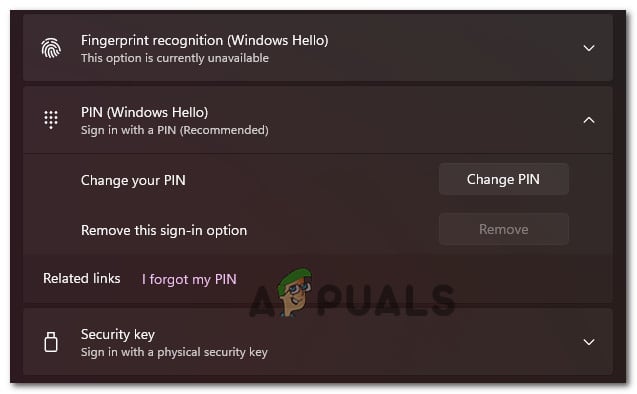
Windows 11 requires you to have at least one Sign-in option enabled. The Remove button will remain grayed out if you only have one active sign-in method.
Can’t disable PIN or Fingerprint on Windows 11
For example, the Remove button for your PIN will stay unavailable until you add a different sign-in option (like Facial Recognition, Fingerprint, or a Security Key).
If you want to stop using your PIN or Fingerprint, you’ll need to set up an additional way to sign in.
Below are step-by-step instructions to set up a new sign-in option and then remove your current one:
- Press Windows key + I to open the Settings menu in Windows 11.
- Inside the Settings menu, click on Accounts from the vertical menu on the left. Accessing the Accounts menu Note: If the left menu is hidden by default, click the menu button (top-left corner) to reveal it.
- Once in the Accounts menu, move to the right-hand section of the screen and select Sign-in options. Accessing the Sign In Options menu
- Now, choose which sign-in method you’d like to set as a fallback. Sign-in Options Note: Your available options depend on your device. If your PC doesn’t support facial recognition or you don’t have a security key, you can switch between PIN and fingerprint.
- After you pick your new sign-in method, follow the on-screen instructions to set it up.
- Once your second sign-in option is set, you’ll be able to click the Remove button to get rid of your previous sign-in method. You can also choose Change PIN or Change Fingerprint to update, rather than remove, your sign-in credentials. Modify the current PIN or remove one of the configured sign-in options
2. Remove PIN or Fingerprint Requirement by Using a Local Account
If you want to completely remove all sign-in options like PIN or Fingerprint, you will have to switch to a local account .
We generally don’t recommend this unless you really need to, as it can limit the functionality of some built-in Windows features (like Windows Update and the Microsoft Store).
If you still want to remove your PIN or Fingerprint sign-in, you’ll need to set up a local account with a password instead. Keep in mind, this means you’ll need to stop using your Microsoft account on your PC.
Important: This method isn’t available if you’re enrolled in the Windows Insider program.
To change from a Microsoft account with PIN or fingerprint to a local password, follow these steps:
- Press Windows + I to open the Settings menu in Windows 11.
- In the Settings menu, click on Accounts from the menu on the left. Accessing the Accounts menu Note: If you don’t see the left menu, click the menu icon (top-left corner).
- Inside Accounts , click on Family & other users on the right-hand side. Accessing the Family and other users tab
- In the Family & other users tab, check for any accounts listed under Other users. If you find any, remove them before moving on.
- Next, return to the main Accounts menu and click on Your info on the right. Accessing the Your Info tab
- Scroll down to Account Settings and click on Sign in with a local account instead . Sign in with a local account instead
- On the next screen, click Next .
- When prompted, enter your current PIN or use your fingerprint as requested. Inserting the PIN
- Then, you’ll be asked to create a username and password for your new local account, along with a password hint in case you forget. Configure the local account
- Finally, click Sign out and finish to complete the switch.
