Despite the professionalism that Microsoft Word documents can convey, unintentionally creating blank or extra pages may undermine the impression given to editors or potential employers. Such additional pages often result from inserting tables, pasting content, or employing shortcuts, which can disrupt the document’s entire formatting.
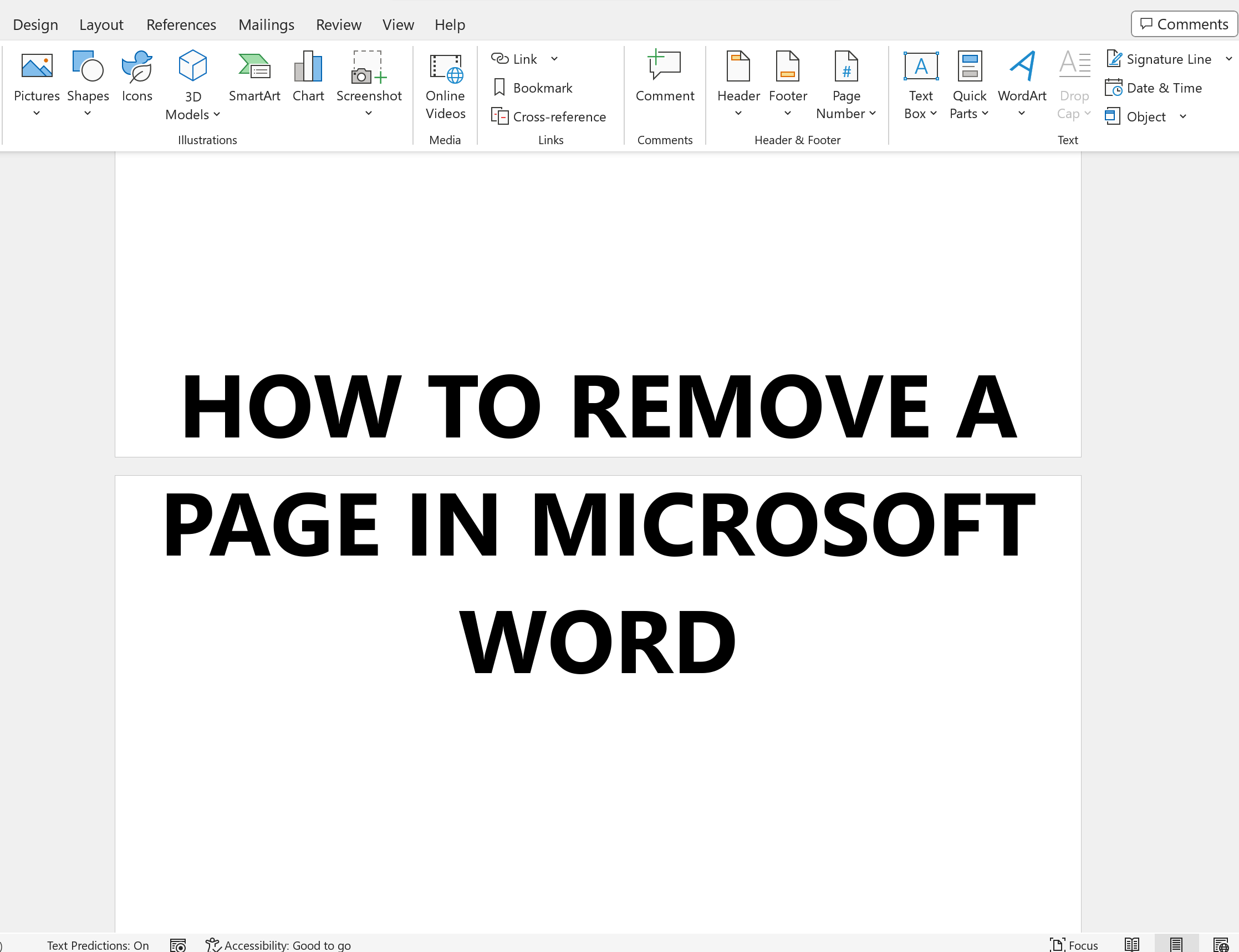
For this reason, it’s prudent to review your document before sharing or exporting to ensure a polished final presentation. Luckily, Microsoft Word provides several straightforward steps to remove unwanted pages. Let’s explore these methods in greater detail!
1. Use the Backspace or Delete Key
A page only persists in a document if there’s content spilling onto it. Once you delete all content from a page, Word will automatically reflow the remaining content and exclude the now unnecessary blank page .
The simplest way to remove a page in Microsoft Word is by using the Backspace or Delete Key. This approach requires you to manually select the page you want to remove.
Initially, this will delete only the page’s content. If you continue pressing the key while your cursor is at the top of the page, the page itself will be removed.
Here is how to execute this process:
- First, click at the bottom of the page you intend to delete.
- Then, press the backspace key or delete key repeatedly. This action will erase all the text from that page, causing the page to disappear as well.
2. Enable the Paragraph Symbol
Sometimes page removal can be obscured by manual page breaks, which are typically not visible.
To reveal these breaks, activate the Paragraph Symbol . This provides the ability to eliminate any symbols or manual page breaks, and consequently, any blank pages.
The steps to do this are as follows:
- Click on the Home tab on the toolbar.
- Select the Show/Hide ¶ icon to display paragraph symbols within your document.
- Locate the page you want to delete and check for the existence of paragraph symbols or formatting marks.
- Select each symbol and press the Delete key on your keyboard. After deleting all paragraph and formatting symbols from the page, the page will also be removed.
Note: It’s important to understand that this method only works for manual page breaks. If a page is automatically generated from content flow, this approach will not remove it.
3. Use the Navigation Pane
The Navigation Pane offers a quick and easy strategy for excising extra pages from your Word document. This feature circumvents the need to manually scroll through the document to locate specific pages by presenting an overall structure of the document contents.
Take these steps to use this feature:
- Open the View tab on the document’s top menu.
- In the Show section, check the box next to Navigation Pane to display it on the left side of the document.
- Within the Navigation Pane , click on Pages and select the page you wish to delete.
- Press the Delete key to remove it.
- Repeat these steps for any additional pages you intend to delete.
4. Use the Find and Replace Tool
The Find and Replace Tool is another convenient way to remove an entire page and its contents from a Microsoft Word document. This tool lets you quickly navigate to and select all the content on a desired page with just a click.
To use this method, follow the steps below:
- Click on the page you want to delete and press Ctrl+G on your keyboard to open the Find and Replace dialog box.
- In the Enter page number field, type ‘ \page ’.
- Click Go To or hit the Enter key , which will select all the content of the target page.
- Close the dialog and press the Delete/Backspace key to erase the page.
5. Adjusting the Document Margins
Sometimes, an extra page is a result of large margins that push content onto the next page. Adjusting margins can condense content and possibly eliminate the need for that extra page.
To adjust your document’s margins, follow these steps:
- Go to the Layout tab in the top menu.
- Click on Margins and select one of the preset margin sizes, or choose Custom Margins… to enter your specific preferences.
- After adjusting the margins, check your document to see if the extra page has been removed.
6. Manually Adjust Paragraph Spacing
Similar to margins, paragraph spacing can also contribute to the creation of unwanted pages. Reducing the space before or after paragraphs can pull text back, removing the extra page.
Here’s how to alter paragraph spacing:
- Select the text you want to modify or press Ctrl + A to select the entire document.
- Right-click on the selected text and choose Paragraph…
- Under the Spacing section, reduce the values for Before or After , or set them to zero if needed.
- Click OK to apply the changes and check if the extra page is removed.
7. Utilizing Section Breaks Wisely
Section breaks can inadvertently create extra pages. Understanding and managing section breaks can help you maintain a cleaner document.
To manage section breaks:
- Enable the Paragraph Symbol to view hidden formatting symbols, including section breaks.
- Locate the section break that might be causing an extra page.
- Select the section break and press the Delete key .
Note: Be cautious when deleting section breaks as they can affect the formatting of your document.
8. Final Check with Print Preview
Before finalizing your document, use the Print Preview feature to ensure that all unwanted pages are indeed gone and that your formatting remains intact.
Access Print Preview like so:
- Go to the File tab and select Print from the left pane to open Print Preview.
- Review the entire document, scrolling through each page to ensure no extra pages are present.
By integrating these additional tips and methods into your article, readers can achieve even better results in maintaining the professional appearance of their Microsoft Word documents.
How to Fix “Printer is in an error state” Issue?
Nothing is more terrifying than when a printer stops doing what it’s supposed to do, printing. And it gets worse if you have just installed a new cartridge. The time when you expect a shining print, all you get is a blank page. This issue can also occur in a printer that is using an old cartridge.
Mostly it is a hardware issue responsible for this. But hardware is only as good as the drivers or software you are using on your computer, so the issue can be caused by that end too.
Follow the guidelines stated below to troubleshoot the issue.
Inspect Cartridge
Incorrect installation of the cartridge can stop it from printing hence blank pages will be printed. In case this issue has started appearing after installing a new cartridge, a common mistake that you could have made is failing to remove the protective sheet or cover on the cartridge before inserting it into the printer. It is used to protect the sensitive part of the cartridge drum getting damaged or dirty. You have to remove it before you can use the cartridge.
Firstly, take your cartridge out . Based on your cartridge type, the protective tape (usually orange/yellow in color) can be of different types and in a different location.
In some printers, there is a colored tab on the new cartridge. Pull it and the protective sheet will be removed. In some, it a plastic little sheet placed on the contacts and ink nozzle. You just have to pull it off to remove it.

You will have to consult the manual for your exact printer’s model to know the location of the protective sheet. A user can easily miss this, so make sure you double-check it. Once done, firmly insert the cartridge(s) back into the printer.
Check Ink Levels
Make sure the ink cartridges are not completely empty. You can easily check that by printing out a report by using the menu buttons on your printer.
It will be mentioned as “ Ink Levels ” or “ Print Quality ” as it differs by your printer’s model. Or you can consult your printer’s manual to see the exact way to check Ink levels.
If there is no ink in the black cartridge, then, of course, you will be unable to print.
In the case of some color printers (Epson’s, for example), completely empty color cartridges can also cause your printer to print blank pages even if you are printing a black and white document. The reason behind this is that a little amount of colored ink is required to keep the heads of the printer clean.
Unclog Print Heads
If you have not used your printer for a long time, a heavy amount of ink can dry up and clog at the print heads on the cartridge. To unclog them, in most printers there is an option to clear print heads or print nozzles in the menu of the printer or in the software that came with the printer installed on your computer.
To manually unclog and clean the printer head , turn the printer on. Remove the cartridge from the printer.
The location of the print head varies by printer brand and location. It’s usually the place where the protective sheet is placed in a new cartridge. Once again you will have to consult its manual to know the exact location. Once you find it, clean it with a lint-free cloth and cotton swabs .
To stop this problem from happening in the future, make sure you print a page at least once every 3 days .
Use Another Software
Try different software to print your file. For example, if you are using Microsoft Word to print a document, then save it as a PDF and use Adobe Reader instead to open and print it.
Update Printers Drivers
An outdated driver can be messing up your print command. To install updates , visit your printer’s manufacturer’s website .
- Once there, type in your exact printer’s model and search for the Download or Support section of your model.
- In there, download the drivers that are specifically made for your operating system (e.g. Windows 7 x86, Windows 10 x64, Mac OS, etc.)
- Install them and check. If there are no drivers available for Windows 10, you can try Windows 8/8.1 drivers instead.
The error “ WinRAR Error: Next Volume Is Required ” usually appears when you’re extracting a multi-part RAR archive and WinRAR can’t find (or can’t correctly identify) the next file in the sequence . This often happens when a volume is missing , stored in a different folder , or renamed in a way that breaks the archive’s expected order .

In this guide, we’ll go over the most reliable fixes confirmed by affected users, along with what each method is doing behind the scenes so you can choose the right one for your situation.
Important: To extract multi-volume archives, you should always start extraction from the first file in the set. This is usually file.part1.rar , or (in older sets) the main .rar file that comes before .r01 , .r02 , and so on.
1. Download and Place the Missing RAR File
WinRAR needs all parts of a multi-volume archive to complete extraction. This error usually appears when one of the volumes in a set like .part2.rar , .r01 , .r02 , .001 , and similar naming formats is missing . Downloading the missing volume and placing it in the same folder as the other parts allows WinRAR to continue extracting normally .
- Look at the error message or review the list of archive parts in the folder.
- Identify which volume is missing (for example, part2.rar , .r02 , .001 , etc.).
- Go back to the website or source where you downloaded the archive.
- Locate and download the exact missing file using the same naming format as the others.
- Make sure the new file name matches the pattern of the rest. Example: If you have file.part1.rar and file.part3.rar , the missing one must be file.part2.rar .
- Move the downloaded missing volume into the same folder as the other archive parts.
- Confirm that all parts are in a single folder before extracting.
- Right-click the first file in the series (usually part1 or the main .rar file) and select Extract Here or Extract to Folder .
- WinRAR should now detect all volumes and continue extraction normally .
2. Manually Browse & Select the Next Volume
Use this method only if the next volume already exists , but WinRAR is failing to detect it automatically. This can happen due to incorrect naming , the file being in a different location , or a temporary file access issue. Manually browsing helps WinRAR locate the correct volume and resume extraction without interruption .
- Right-click the first file in the series (usually .rar or part1.rar ) and select Extract Here or Extract to Folder .
- When WinRAR cannot find the next volume, it will show the “ Next Volume Is Required ” message.
- A small window will appear, allowing you to manually select the next volume .
- Use the file explorer window to locate the folder where the other archive parts are saved.
- Select the next part based on the naming order (example: select file.part2.rar after file.part1.rar ).
- Make sure the selected file matches the naming format of the archive (no extra characters like (1) and no mismatched numbering).
- WinRAR will resume extraction using the selected volume .
- If additional volumes are missing or stored separately, WinRAR may prompt you again. Repeat the same process until extraction completes.
3. Rename the RAR files in Order
WinRAR relies on a proper naming sequence (such as file.part1.rar , file.part2.rar , file.part3.rar ) to extract multi-volume archives. If a file is named incorrectly, contains extra characters, or is out of order, WinRAR may fail to locate the next volume and show this error. Renaming the files correctly helps WinRAR follow the sequence and extract the archive without interruptions .
Note: Renaming only changes the file name , not the file contents. The goal is to restore the correct sequence so WinRAR can detect the next volume.
- Go to the folder where all the RAR files are saved.
- Make sure all parts of the archive are present and stored in the same folder .
- Check how the parts are currently named . Common patterns include:
file.part1.rar, file.part2.rar, file.part3.rar
file.rar, file.r01, file.r02, file.r03
- Look for files that don’t match the expected numbering pattern (for example, file.part01.rar , file.part1(1).rar , or unrelated names).
- Rename each file so it follows the same order without extra characters or mismatched numbering. Example:
Incorrect: file.part1.rar, file.part3.rar, file.part2(1).rar
Correct: file.part1.rar, file.part2.rar, file.part3.rar
- Make sure the text before the number is exactly the same for all files.
- Only the last part number should change.
- Right-click the first file in the series (usually part1.rar or the main .rar file) and select Extract Here .
- WinRAR should now recognize the sequence and continue extraction normally .
If you still get the same prompt: the archive set is likely incomplete (a part was never downloaded or was removed), or one of the volumes is corrupt and must be re-downloaded from the original source.
