Heart rate or pulse rate is the most important parameter that is measured in the field of medicine. There are two ways in which the heart rate can be measured. One is to manually check the wrist by using a stethoscope and guessing the heart rate, the other method is to use a heart rate sensor. A heart rate sensor gets some readings of the pulse and sends an electrical signal to the microcontroller, these readings are then calculated and the exact pulse rate is displayed.
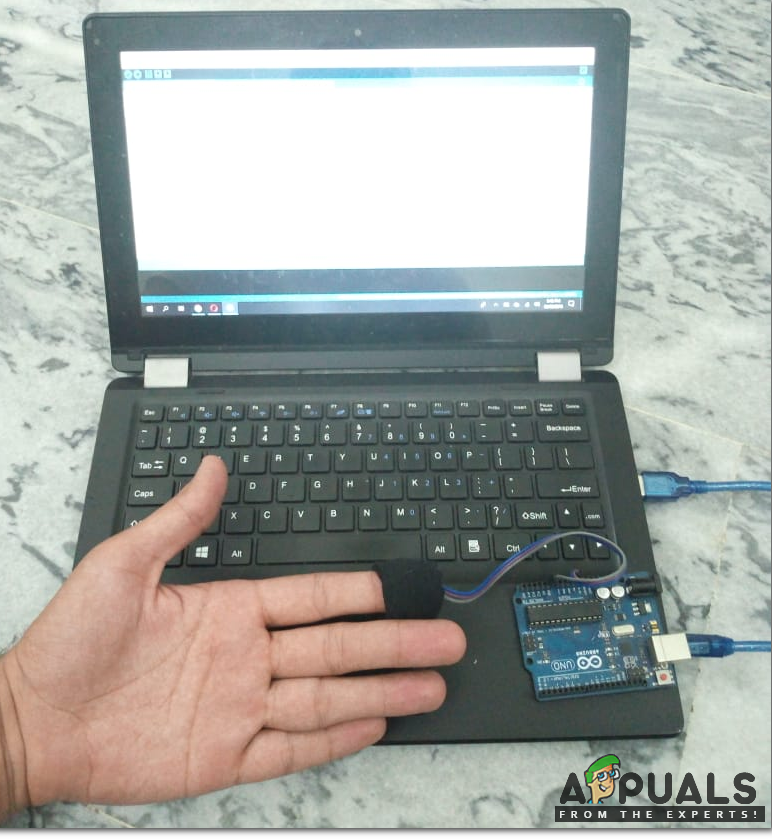
Measuring Heart Rate
How a Heart Rate Sensor Measures the Pulse rate?
As we know what we are going to do, so let’s start working on this project.
Step 1: Collecting the Components
Making a list of components and studying the working of those components is the best approach before starting any project. Following are the components that will be used in our project:
- No products found.
- No products found.
- No products found.
- No products found.
- No products found.
Step 2: Knowing the Components Used
As we have the list of apparatus that we are going to use. Now let us see how these components work.
Arduino Uno is a microcontroller board that is used to control various circuits. It uses a C code that gives it the instructions to perform a task. Other substitutes of this microcontroller board available in the market are Arduino Nano, Node MCU, ESP32, etc.
SEN-11574 is a plug and play pulse rate sensor that is integrated with Arduino. It has two sides. On one side, a led is placed which emits light. This led should be placed directly on the top of a vein. As we know that the volume of blood in the vein is greater when the heart pumps, so when there is more blood in the vein, more light will be reflected to the sensor. This change in the light received by the sensor is analyzed over time and the heart rate is measured. On the other side of the sensor, a circuit is present which is responsible for the amplification and noise removing of the received signal.
Step 3: Assembling the components
- As we know that the skin is of a human body, is moist or oily sometimes. This could result in the short circuit of the sensor which gives false measurements. It is better to apply a layer of a vinyl sticker on the LED side of the sensor to prevent it from the moist on the skin.
- After doing this, take a piece of black vector tape and paste it on the other side of the sensor. This will prevent light from the surroundings to interrupt the light of the sensors.
- Now, connect the Vcc and ground pin of the sensor to Arduino and the analog pin of the sensor to A0 of Arduino.
All the apparatus is now set and ready to be used. We will put the sensor directly on the vein, either on the finger or the ear to measure the heart rate.
Step 4: Getting Started with Arduino
If you haven’t worked on Arduino IDE before, don’t worry because the procedure to burn a code on the microcontroller board using Arduino IDE is given below.
- After connecting your Arduino board to your PC, go to Control Panel > Hardware and Sound > Devices and Printers to check the name of the port to which Arduino is connected. It is different on different computers. Finding Port
- Open the Arduino IDE and set the board as Arduino/Genuino UNO. Setting Board
- Now set the port that you observed before in control panel. Setting Port
- Download the code given below and open it. Burn the code on your Microcontroller board by clicking the Upload button. Upload
Step 5: Code
The code to measure the pulse rate is a little bit lengthy and complicated. Some part of the code is explained below.
In the start, all the pins that will be used are defined. All the variables that will be used in different functions and the interrupt service routine (ISR).
void setup() is a function in which Pins are defined to be used as INPUT or OUTPUT. baud rate is also set in this function. Baud rate is the speed by which the microcontroller communicates with other components. ISR is also called in this function.
void loop() is a function that runs continuously in a cycle. Here, pulse rate is found and it decides when to fade the led when a heartbeat is found.
void loop() {

serialOutput() ;

if (QS == true) { // A Heartbeat Was Found

// BPM and IBI have been Determined

// Quantified Self "QS" true when arduino finds a heartbeat

fadeRate = 255; // Makes the LED Fade Effect Happen

// Set 'fadeRate' Variable to 255 to fade LED with pulse

serialOutputWhenBeatHappens(); // A Beat Happened, Output that to serial.

QS = false; // reset the Quantified Self flag for next time

}

ledFadeToBeat(); // Makes the LED Fade Effect Happen

delay(20); // take a break

}
- void serialOutput() is a function which decides how to show output on the serial monitor.
void serialOutput(){

switch(outputType){

case PROCESSING_VISUALIZER:

sendDataToSerial('S', Signal); // goes to sendDataToSerial function

break;

case SERIAL_PLOTTER: // open the Arduino Serial Plotter to visualize these data

Serial.print(BPM);

Serial.print(",");

Serial.print(IBI);

Serial.print(",");

Serial.println(Signal);

break;

default:

break;

}

}
- ISR is an interrupt that is generated by the hardware and sent to the CPU for processing. when the interrupt is generated, the process, which is already going on stops and the interrupt is processed. after the interrupt is processed, the previous process resumes.
void interruptSetup() { // CHECK OUT THE Timer_Interrupt_Notes TAB FOR MORE ON INTERRUPTS

#ifndef ESP32

// Initializes Timer2 to throw an interrupt every 2mS.

TCCR2A = 0x02; // DISABLE PWM ON DIGITAL PINS 3 AND 11, AND GO INTO CTC MODE

TCCR2B = 0x06; // DON'T FORCE COMPARE, 256 PRESCALER

OCR2A = 0X7C; // SET THE TOP OF THE COUNT TO 124 FOR 500Hz SAMPLE RATE

TIMSK2 = 0x02; // ENABLE INTERRUPT ON MATCH BETWEEN TIMER2 AND OCR2A

sei(); // MAKE SURE GLOBAL INTERRUPTS ARE ENABLED

// Create semaphore to inform us when the timer has fired

#else

timerSemaphore = xSemaphoreCreateBinary();


// Use 1st timer of 4 (counted from zero).

// Set 80 divider for prescaler (see ESP32 Technical Reference Manual for more

// info).

timer = timerBegin(0, 80, true);


// Attach onTimer function to our timer.

timerAttachInterrupt(timer, &onTimer, true);


// Set alarm to call onTimer function every second (value in microseconds).

// Repeat the alarm (third parameter)

timerAlarmWrite(timer, 2000, true);


// Start an alarm

timerAlarmEnable(timer);

#endif

}
Applications:
Now as we know how to measure the Pulse rate using a heart rate sensor. Now we can use it to make different projects for example
- Health bands.
- Anxiety Monitor.
- Sleep Tracking.
- Remote patient monitoring/alarm system.
- Advanced gaming consoles
How to Fix “Printer is in an error state” Issue?
- Recognizing the importance of a printer’s duty cycle is crucial for choosing a device that matches your print volume needs. Staying within this limit ensures the printer operates efficiently and prolongs its lifespan, minimizing the risk of maintenance issues.
- Proper humidity, temperature, and cleanliness management can significantly enhance printer performance and maintain its duty cycle, preventing unnecessary wear.
- Enhancing a printer with upgrades like additional memory or better mechanical parts can improve its workload handling and extend its practical duty cycle, boosting overall durability and efficiency.
When choosing a new printer, you might come across the term “ duty cycle ” in the specifications. This guide will explain what a duty cycle is, why it matters, and how it can help you choose the right printer. We’ll keep things simple so you can easily understand how to use this information when shopping for a printer.
- Printer Duty Cycle: What It Means and Why It Matters?
- Why the Duty Cycle Is Key to Choosing the Right Printer?
- Duty Cycle vs. Recommended Monthly Print Volume: What’s the Difference?
- What Happens If You Ignore Printer Duty Cycle Recommendations? ↪ Real-World Scenarios: Why Exceeding the Duty Cycle Can Cost You
Printer Duty Cycle: What It Means and Why It Matters?

What is the meaning of Printer Duty Cycle?
The printer duty cycle represents the upper limit of a printer’s capacity—how many pages it can reliably process in a month before the risk of wear or malfunction increases. This figure is crucial for understanding printer performance limits and ensuring that your chosen printer can handle the expected work volume.
Manufacturers determine a printer’s duty cycle through stress testing, where the printer is pushed to its limit to identify how many pages it can produce each month before malfunctioning. These tests help set a reliable performance gateway for users.
A printer’s duty cycle is like a car’s speedometer—you wouldn’t drive a car at top speed all the time, and you shouldn’t push a printer to its maximum duty cycle. Doing so can lead to quicker wear and tear, more frequent maintenance, and a shorter lifespan.
If you’re unsure whether to choose an inkjet or laser printer, this detailed guide compares both options to help you make an informed decision.
Why the Duty Cycle Is Key to Choosing the Right Printer?

The Importance of Duty Cycle in printer selection
Knowing the duty cycle is essential when choosing a printer, as it determines how well the device can handle your monthly print volume without excessive wear or maintenance.
Here is why the duty cycle matters in printer selection:
- Fit for purpose: Selecting a printer with a suitable duty cycle ensures it can handle your monthly printing volume efficiently, reducing stress on its components.
- Longer lifespan and better performance: Staying within the duty cycle ensures optimal print quality and speed while prolonging the printer’s life, avoiding frequent breakdowns.
- Cost efficiency and reduced downtime: Operating within the duty cycle minimizes the need for repairs and reduces operational disruptions, managing long-term costs.
Duty Cycle vs. Recommended Monthly Print Volume: What’s the Difference?

Duty Cycle vs. recommended monthly print volume
The recommended monthly print volume is the optimal number of pages a printer should handle each month for the best performance and longevity. Unlike the maximum capacity indicated by the duty cycle, this number guides regular usage, ensuring the printer operates efficiently without excessive wear.
If your print volume regularly exceeds the recommended amount but stays within the duty cycle, the printer may operate safely in the short term, but it could still experience accelerated wear and reduced lifespan over time.
In such cases, consider upgrading to a higher-capacity printer or spreading print jobs across multiple devices to ensure long-term performance.
Here are the differences between the duty cycle and recommended monthly print volume:
- Duty cycle: Represents the maximum number of pages a printer can handle in a month without breaking down. It assesses the printer’s upper limit.
- Recommended monthly print volume: Suggests a practical, workable number of pages to print each month to keep the printer in good condition over its lifespan.
What Happens If You Ignore Printer Duty Cycle Recommendations?

Consequences of ignoring Duty Cycle recommendations |AndranikHakobyan via Canva
Ignoring the duty cycle limits poses more severe risks than exceeding the recommended monthly print volume, leading to serious long-term consequences.
While exceeding the recommended volume occasionally may result in additional wear and tear, consistently exceeding the duty cycle can lead to frequent breakdowns, reduced performance, and a shortened lifespan.
Ignoring duty cycle limits leads to frequent breakdowns, reduced performance, and increased maintenance, ultimately shortening the printer’s lifespan and causing more frequent operational downtime and higher repair costs. Long-term, pushing a printer beyond its limits leads to greater financial burdens due to premature replacements and inefficiencies.
↪ Real-World Scenarios: Why Exceeding the Duty Cycle Can Cost You
For example, in a busy law firm, overlooking duty cycle limits during a high-stakes period could cause a printer breakdown just before a critical deadline, delaying crucial legal filings and ultimately compromising client service.
For small businesses, consistently exceeding a printer’s duty cycle can lead to costly emergency repairs or premature equipment replacements, straining financial resources.
