If you are looking for ways to install Fedora workstation on your Virtual Box Machine, then you may find it amusing that there is a simple method to install this powerful operating system for your desktop. Following the steps below, you will learn how to Install and set up the Fedora Workstation on your Virtual Box machine.

How to Install Fedora Workstation on Oracle VM Virtual Box
Step 1: Download the Fedora ISO File
To install Fedora, it is necessary to have its ISO file, which you can load into VMware and start the installation process. Therefore, we will download the ISO file of fedora first.
- Open the official Fedora webpage.
- Click “Download Now” on the Fedora Workstation. Downloading Fedora Workstation
Click on the x86_64 Live ISO Download button.
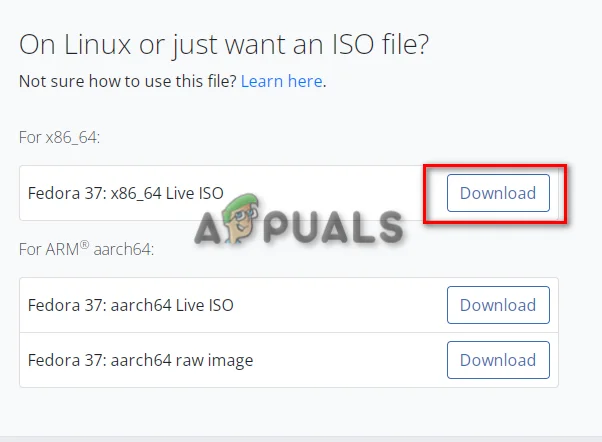
Downloading Fedora ISO File
Once the ISO file is downloaded, you can move to Step 2.
Step 2: Setting up Virtual Box for the Installation process
Before installing the fedora on Virtual Box, you must adjust the settings of Virtual Box according to your needs. Follow these steps:
- Open your Virtual Box and Click on the “New” option on top of the screen to open the Virtual Machine Creation page. Setting up Fedora on Virtual Box
- Type in “Fedora” as the File Name.
- Change the Version of the Machine by selecting “Fedora (64-bit).”
- Select “Linux” as the primary operating system type for the Machine and click on the Next button. Creating a Virtual Machine
- Set your Base Memory to 2048 MB and the Processors to 1 . (You can adjust the Memory and Processors that you want to dedicate to Fedora as you wish.)
- Uncheck the “Enable EFI” option below and click on the Next button. Modifying the Virtual Machine’s hardware
- Click on the “Create a Virtual Hard Disk Now” option and set the Disk Size to 15.00 GB.
- Un-check the “Pre-allocated Full Size” option and click on the Next button. Creating a Virtual Hard Disk
- Click the Finish button on the Summary page. Finalizing Virtual Machine Creation
Step 3: Load the ISO file into Virtual Optical Disk
After setting up the Virtual Box for the Installation process, you must load the ISO file so that Virtual Box can detect the Fedora installation disk. Follow these steps:
- Click on the Settings option at the top of the screen to open the Fedora Settings page. Opening the Fedora Settings
- Click on the Storage option on the right side of the panel.
- On the Storage Device option, click on the Optical Disk Operator icon. Adding Fedora Workstation into the Fedora Storage
- Click on the Add option on the Optical Disk Operator page. Adding Fedora Workstation file on the Fedora Optical Disk
- Find the location where you downloaded the Fedora Workstation ISO File.
- Click on the downloaded file and then click on Open. Locating the Fedora Workstation file on the Disk
- Click on the “Choose” button.
- Click on OK. Confirming Fedora Settings
Step 4: Installation Process of Fedora
Let’s start installing Fedora now. Follow these steps:-
- Click on the Start Button at the top of the screen to start the Virtual Machine. Starting Fedora on the Virtual Machine
- Wait for for the Virtual Machine to turn on.
- Once you are on the Welcome to Fedora Screen.
- Click on the “install Fedora to Hard Drive” Option on the screen. Installing Fedora into the Hard Drive
- Select the Type of Language you want to assign to the system and click on “Continue.” Selecting Language for Fedora
- Click on the “Installation Desitination” option under “System” to decide where you want to install Fedora, and click on “Done.”
- Click on Begin Installation to initiate the installation process. Selecting Installation Destination for Fedora
- Click on “Root Password” and “User Creation” to set up your account on Fedora.
- Click on Finish Configuration and let the installation complete. Finishing Configuration of Fedora
- Click on Quit to fully install Fedora Workstation on your VirtualBox machine. Quitting Installation Configuration
Note: Once you have followed each step we have listed above, you will Install and set up Fedora on your Virtual Box and can perform activities on the Virtual Machine, such as creating Terminals and accessing other features on Linux. However, note that when you click the start button at the end of the process, ensure not to press any key on your keyboard since any action from the keyboard will interfere with the Initiation of Fedora Live.
How to Fix “Printer is in an error state” Issue?
The error “ WinRAR Error: Next Volume Is Required ” usually appears when you’re extracting a multi-part RAR archive and WinRAR can’t find (or can’t correctly identify) the next file in the sequence . This often happens when a volume is missing , stored in a different folder , or renamed in a way that breaks the archive’s expected order .

In this guide, we’ll go over the most reliable fixes confirmed by affected users, along with what each method is doing behind the scenes so you can choose the right one for your situation.
Important: To extract multi-volume archives, you should always start extraction from the first file in the set. This is usually file.part1.rar , or (in older sets) the main .rar file that comes before .r01 , .r02 , and so on.
1. Download and Place the Missing RAR File
WinRAR needs all parts of a multi-volume archive to complete extraction. This error usually appears when one of the volumes in a set like .part2.rar , .r01 , .r02 , .001 , and similar naming formats is missing . Downloading the missing volume and placing it in the same folder as the other parts allows WinRAR to continue extracting normally .
- Look at the error message or review the list of archive parts in the folder.
- Identify which volume is missing (for example, part2.rar , .r02 , .001 , etc.).
- Go back to the website or source where you downloaded the archive.
- Locate and download the exact missing file using the same naming format as the others.
- Make sure the new file name matches the pattern of the rest. Example: If you have file.part1.rar and file.part3.rar , the missing one must be file.part2.rar .
- Move the downloaded missing volume into the same folder as the other archive parts.
- Confirm that all parts are in a single folder before extracting.
- Right-click the first file in the series (usually part1 or the main .rar file) and select Extract Here or Extract to Folder .
- WinRAR should now detect all volumes and continue extraction normally .
2. Manually Browse & Select the Next Volume
Use this method only if the next volume already exists , but WinRAR is failing to detect it automatically. This can happen due to incorrect naming , the file being in a different location , or a temporary file access issue. Manually browsing helps WinRAR locate the correct volume and resume extraction without interruption .
- Right-click the first file in the series (usually .rar or part1.rar ) and select Extract Here or Extract to Folder .
- When WinRAR cannot find the next volume, it will show the “ Next Volume Is Required ” message.
- A small window will appear, allowing you to manually select the next volume .
- Use the file explorer window to locate the folder where the other archive parts are saved.
- Select the next part based on the naming order (example: select file.part2.rar after file.part1.rar ).
- Make sure the selected file matches the naming format of the archive (no extra characters like (1) and no mismatched numbering).
- WinRAR will resume extraction using the selected volume .
- If additional volumes are missing or stored separately, WinRAR may prompt you again. Repeat the same process until extraction completes.
3. Rename the RAR files in Order
WinRAR relies on a proper naming sequence (such as file.part1.rar , file.part2.rar , file.part3.rar ) to extract multi-volume archives. If a file is named incorrectly, contains extra characters, or is out of order, WinRAR may fail to locate the next volume and show this error. Renaming the files correctly helps WinRAR follow the sequence and extract the archive without interruptions .
Note: Renaming only changes the file name , not the file contents. The goal is to restore the correct sequence so WinRAR can detect the next volume.
- Go to the folder where all the RAR files are saved.
- Make sure all parts of the archive are present and stored in the same folder .
- Check how the parts are currently named . Common patterns include:
file.part1.rar, file.part2.rar, file.part3.rar
file.rar, file.r01, file.r02, file.r03
- Look for files that don’t match the expected numbering pattern (for example, file.part01.rar , file.part1(1).rar , or unrelated names).
- Rename each file so it follows the same order without extra characters or mismatched numbering. Example:
Incorrect: file.part1.rar, file.part3.rar, file.part2(1).rar
Correct: file.part1.rar, file.part2.rar, file.part3.rar
- Make sure the text before the number is exactly the same for all files.
- Only the last part number should change.
- Right-click the first file in the series (usually part1.rar or the main .rar file) and select Extract Here .
- WinRAR should now recognize the sequence and continue extraction normally .
If you still get the same prompt: the archive set is likely incomplete (a part was never downloaded or was removed), or one of the volumes is corrupt and must be re-downloaded from the original source.
