MilkDrop 2 is an incredibly powerful music visualizer plug-in that was originally created for Winamp. Of course, Winamp hasn’t been updated since 2013, and many users have switched to more modern audio players such as Foobar, VLC, or streaming services with built-in local file players like Spotify, iTunes, and Google Music.

Unfortunately, no modern audio player has a powerful visualizer like MilkDrop – but there’s a workaround. We are able to use MilkDrop 2 as a plug-in for Foobar after installing a separate wrapper plug-in, which gives us full MilkDrop 2 functionality. Just follow our very simple guide!
Requirements:
- Foobar2000
- Shpeck Wrapper Plug-in
- Dummy Winamp.exe
First you need to install Foobar2000 and launch it.
Download and extract the shpeck plug-in.
Open Foobar’s File > Preferences > Components, then drag the shpeck .DLL file onto the Components list in Foobar, press the Apply button, and allow Foobar to restart.
Now download and extract the dummy Winamp archive – this is not in fact the full version of Winamp, it is only a copy of Winamp.exe which shpeck needs to reference, but we are not installing Winamp on your PC.
In Foobar, go to File > Preferences > Visualisations > Shpeck, and in the top bar for “Winamp directory”, click the “…” button and point it to the Winamp.exe we downloaded in the previous step.
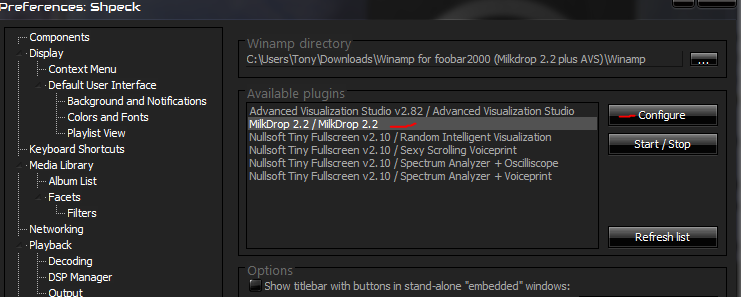
The next menu “Available plugins” should fill up with a few things. Click on “MilkDrop 2.2 / MilkDrop 2.2” and then click “Configure”.
Here you can change a variety of options regarding MilkDrop’s overall quality – if you have an older, slower computer, you should try lowering some settings, but if you have a modern computer or even hardware only a few years old (I’m running an AMD A8-5600k CPU with built-in APU graphics processing), you should be able to maximize the visual quality without any problem.
Under “Common Settings”, you have 3 modes – Desktop, Fullscreen, and Windowed. Fullscreen and Windowed mode are self-explanatory, but Desktop mode means that your desktop wallpaper will MilkDrop. It’s a really cool effect, give it a try.
For “max framerate”, you can put it at 60 frames/sec, but some visualisations may have actually been coded for a different framerate.
“Allow Page Tearing” is basically V-sync. You can disable or enable this, its up to you.
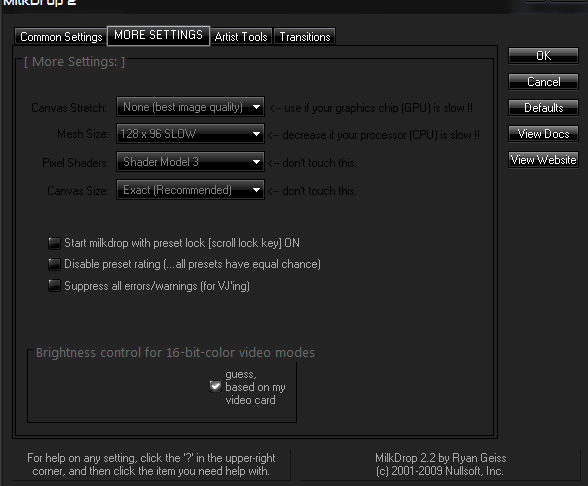
Now under “MORE SETTINGS”, you have these options:
- Canvas Stretch – This option lets you trade resolution [crispness] for speed. If MilkDrop runs too slow, in any mode (windowed/fullscreen/desktop), try cranking up the canvas stretch to, say, 1.5X or 2X. The image will not look as crisp, but MilkDrop will probably run much faster. (Assuming that your graphics chip was the bottleneck.)
- Mesh Size – This is the main option that affects how much processor (CPU) MilkDrop uses. If you crank it up far beyond the default, expect to be CPU-bound (where your framerate drops because the CPU is the bottleneck). To get MilkDrop to speed up, drop the Mesh Size back down. The Mesh Size decides how many points on the screen the per-vertex equations will be executed for; the higher the mesh size, the more fidelity you will see in the motion. However, modern computers should have absolutely no problem at higher mesh sizes.
In the “Artist Tools” tab, try matching your GPUs memory to the “Max Video Mem.”
When you’re all done playing with the settings, just hit “Okay”, then start playing a song in Foobar, and go to Foobar’s View > Visualisations > Shpeck – Start ‘MilkDrop 2.2 / MilkDrop 2.2”.
How to Fix “Printer is in an error state” Issue?
The error “ WinRAR Error: Next Volume Is Required ” usually appears when you’re extracting a multi-part RAR archive and WinRAR can’t find (or can’t correctly identify) the next file in the sequence . This often happens when a volume is missing , stored in a different folder , or renamed in a way that breaks the archive’s expected order .

In this guide, we’ll go over the most reliable fixes confirmed by affected users, along with what each method is doing behind the scenes so you can choose the right one for your situation.
Important: To extract multi-volume archives, you should always start extraction from the first file in the set. This is usually file.part1.rar , or (in older sets) the main .rar file that comes before .r01 , .r02 , and so on.
1. Download and Place the Missing RAR File
WinRAR needs all parts of a multi-volume archive to complete extraction. This error usually appears when one of the volumes in a set like .part2.rar , .r01 , .r02 , .001 , and similar naming formats is missing . Downloading the missing volume and placing it in the same folder as the other parts allows WinRAR to continue extracting normally .
- Look at the error message or review the list of archive parts in the folder.
- Identify which volume is missing (for example, part2.rar , .r02 , .001 , etc.).
- Go back to the website or source where you downloaded the archive.
- Locate and download the exact missing file using the same naming format as the others.
- Make sure the new file name matches the pattern of the rest. Example: If you have file.part1.rar and file.part3.rar , the missing one must be file.part2.rar .
- Move the downloaded missing volume into the same folder as the other archive parts.
- Confirm that all parts are in a single folder before extracting.
- Right-click the first file in the series (usually part1 or the main .rar file) and select Extract Here or Extract to Folder .
- WinRAR should now detect all volumes and continue extraction normally .
2. Manually Browse & Select the Next Volume
Use this method only if the next volume already exists , but WinRAR is failing to detect it automatically. This can happen due to incorrect naming , the file being in a different location , or a temporary file access issue. Manually browsing helps WinRAR locate the correct volume and resume extraction without interruption .
- Right-click the first file in the series (usually .rar or part1.rar ) and select Extract Here or Extract to Folder .
- When WinRAR cannot find the next volume, it will show the “ Next Volume Is Required ” message.
- A small window will appear, allowing you to manually select the next volume .
- Use the file explorer window to locate the folder where the other archive parts are saved.
- Select the next part based on the naming order (example: select file.part2.rar after file.part1.rar ).
- Make sure the selected file matches the naming format of the archive (no extra characters like (1) and no mismatched numbering).
- WinRAR will resume extraction using the selected volume .
- If additional volumes are missing or stored separately, WinRAR may prompt you again. Repeat the same process until extraction completes.
3. Rename the RAR files in Order
WinRAR relies on a proper naming sequence (such as file.part1.rar , file.part2.rar , file.part3.rar ) to extract multi-volume archives. If a file is named incorrectly, contains extra characters, or is out of order, WinRAR may fail to locate the next volume and show this error. Renaming the files correctly helps WinRAR follow the sequence and extract the archive without interruptions .
Note: Renaming only changes the file name , not the file contents. The goal is to restore the correct sequence so WinRAR can detect the next volume.
- Go to the folder where all the RAR files are saved.
- Make sure all parts of the archive are present and stored in the same folder .
- Check how the parts are currently named . Common patterns include:
file.part1.rar, file.part2.rar, file.part3.rar
file.rar, file.r01, file.r02, file.r03
- Look for files that don’t match the expected numbering pattern (for example, file.part01.rar , file.part1(1).rar , or unrelated names).
- Rename each file so it follows the same order without extra characters or mismatched numbering. Example:
Incorrect: file.part1.rar, file.part3.rar, file.part2(1).rar
Correct: file.part1.rar, file.part2.rar, file.part3.rar
- Make sure the text before the number is exactly the same for all files.
- Only the last part number should change.
- Right-click the first file in the series (usually part1.rar or the main .rar file) and select Extract Here .
- WinRAR should now recognize the sequence and continue extraction normally .
If you still get the same prompt: the archive set is likely incomplete (a part was never downloaded or was removed), or one of the volumes is corrupt and must be re-downloaded from the original source.
