Raspberry Pi is an economical, atm card-sized machine that plugs into a television or computer monitor. Latest Raspberry Pi models have usually three to four Universal Serial Bus (USB) ports, one ethernet port, and one High Definition Multimedia Interface (HDMI). It can do all that you would anticipate that a work station should do, like playing a superior quality video, making spreadsheets, FM radio station and gaming, etc. With Apple having officially ended its line of AirPort routers, including the AirPlay-empowered AirPort Express, utilizing a Raspberry Pi to fill the gap has turned into a considerably additionally engaging alternative.
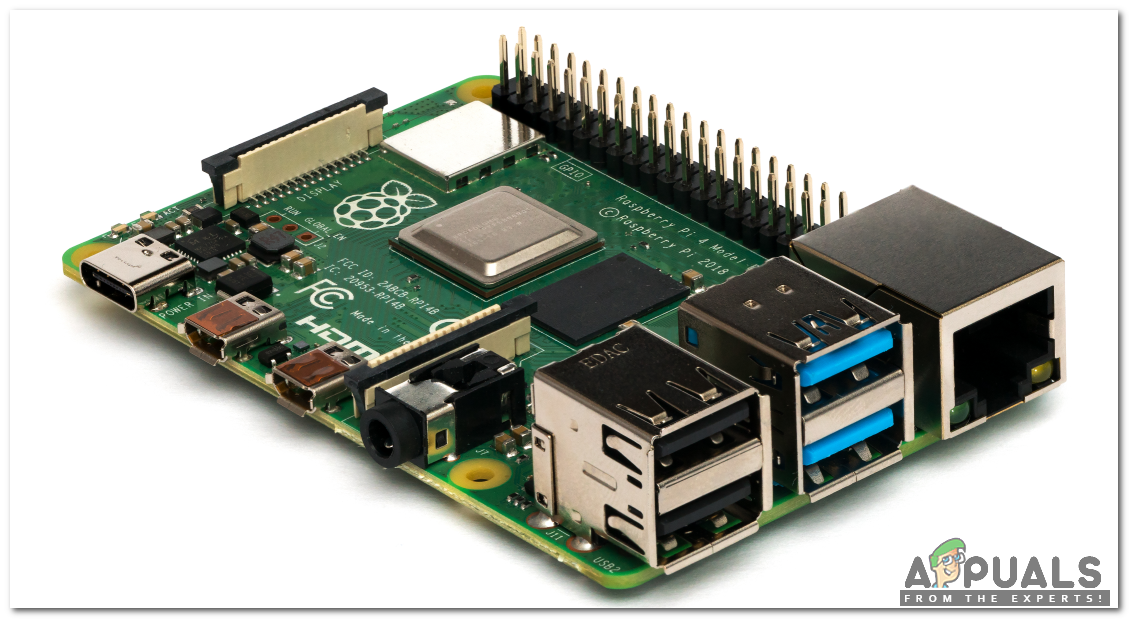
Raspberry Pi
Nowadays, people face numerous problems in setting up Raspberry Pi and especially making a server on Pi is a very hectic task, so, we devised a setup process of Raspberry, especially for beginners.
How To Setup Raspberry Pi And Configure Airplay Server On It?
Now, let’s move towards setting up Pi and doing operations mentioned as under in order to design an airplay server on it.
Step 1: Selecting the Raspberry Pi Model
Several models of raspberry pi are available in the market. Except for raspberry pi zero, any model can be preferred. This is because on Pi zero setting up a network is a very tiring job. The latest models like 3A+, 3B+ or 4 can be purchased. The new Raspberry Pi 3 is the quickest and most dominant gadget the Raspberry Pi Foundation has released to date. It accompanies a 1.2GHz quad-center ARM Cortex-A53 and 1GB LPDDR2 RAM.

Raspberry 3B+
Step 2: Choosing An Operating System:
Firstly, we will need an SD card with an appropriate operating system. When picking the OS, nowadays there are various alternatives, from “conventional” Raspbian to devoted media working frameworks, and even Windows 10 IoT. There is no need for lots of applications hence, we should leave the Central Processing Unit (CPU) and Random Access Memory (RAM) as much as we can for the media streaming application. One problem is that Arch Linux is recommended for people who have quite a lot of Linux knowledge. They’re very front line and we’re bound to keep running into issues when introducing third-party applications and libraries. Thus, if this is your first establishment of an Airplay gadget, we suggest picking Raspbian Lite . It’s command-line driven, and can without much of a stretch designed to keep running in “headless” mode, i.e. accessed entirely remotely over the system with no requirement for a console or screen.
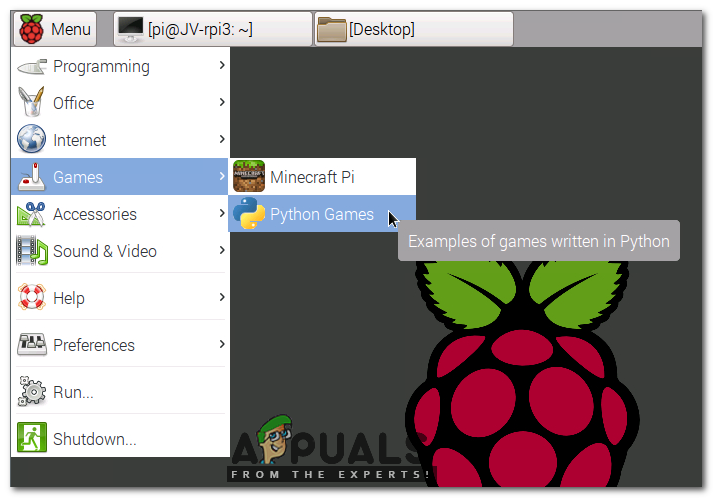
Raspbian
Step 3: Installing Raspbian Lite And Enabling Secure Shell (SSH):
After installing Raspbian Lite and enabling SSH we will move towards configuring the Airplay Server.
You can download Raspbian from Here
1). Install Dependencies: Most importantly, we’ll have to introduce a few conditions so we can assemble the Airplay server application. Run the following :
sudo apt-get update

sudo apt-get install autoconf automake avahi-daemon build-essential git libasound2-dev libavahi-client-dev libconfig-dev libdaemon-dev libpopt-dev libssl-dev libtool xmltoman

Installing Dependencies
2). Build & Install (shairport-sync): shairport-sync transforms your Linux machine into an Apple Airplay server. Perhaps the best thing about it is that it runs totally on the command line, and keeping in mind that it has a million arrangement alternatives, it’s shockingly simple to get working out of the box. Firstly, download its library from Github as follows:
git clone https://github.com/mikebrady/shairport-sync.git

Installing shairport-sync from Github
Now, explore the shairport-sync directory and configure the build:-
cd shairport-sync

autoreconf -i -f

./configure --with-alsa --with-avahi --with-ssl=openssl --with-systemd --with-metadata

Navigating to the shairport-sync directory
Finally, build and install the application:
make

sudo make install

Installing the Application
After completing all the mentioned steps above we should have a working installation of shairport-sync.
Step 4: Configuring The Audio Output
We are now ready to test the Airplay Audio. For that, some hardware components are required. The required hardware components are listed below :
(Headphones, active speakers from a desktop pc, hi-fi amplifier with a cable that converts 3.5mm jack to a pair of RCA phono plugs).
Now, we need to configure the audio path on raspberry pi. It’s commonly set to “auto” however you have to drive it to go to the 3.5mm jack. Run raspi-config :-
sudo raspi-config

Heading Into Configuration Mode
Select “7. Advanced Options”, then “A4. Audio”, then choose Option 1 “Force 3.5mm (‘headphone’) jack”. This will constrain the sound way to the 3.5mm earphone jack.
Step 5: Set The Volume
The volume will, in general, be extremely low, so transform it to max using the following command :
amixer sset PCM,0 100%

Maximizing The Volume
The volume setting is somewhat hard to utilize in light of the fact that it’s designed in dB (decibels), which in case you’re not a specialist are extremely unintuitive. Lowering the volume with the amixer command and desired percentage is not recommended because if you lower the percentage it becomes barely audible for the listener.
Step 6: Test Airplay to the Raspberry Pi
Now start shairport-sync with the following command :
sudo service shairport-sync start
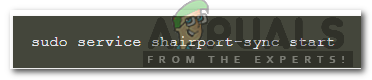
Starting shairport-sync
Now, we will have to start air playing to it so grab an iPhone that supports Airplay, and ensure that Raspberry Pi and the iPhone are on the same network. Begin playing some music, and from the Airplay icon select “raspberry pi” and after that “Done”.
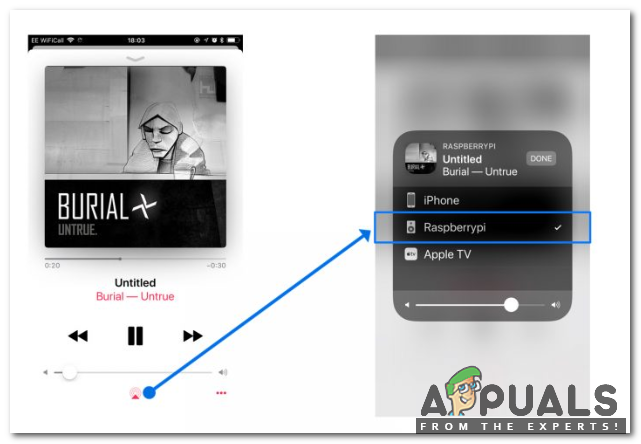
Selecting Raspberry Pi via Airplay from iPhone’s Music Playback Screen
Step7: Configureshairport-syncto Start Automatically
Starting media player services is no doubt a very tiring job so we want shairport-sync to run as soon as Pi is booted. For enabling the service to launch automatically we will use the command :
sudo systemctl enable shairport-sync

Enabling shairport-sync
After writing the command for enabling shairport-sync the output should be as follows :
Created symlink /etc/systemd/system/multi-user.target.wants/shairport-sync.service → /lib/systemd/system/shairport-sync.service.

Output
Now that we’ve created an Airplay server all we need to do is Reboot Pi by using the command “sudo reboot” and we have the option to Airplay to the raspberry pi every time we boot it up.
Step 8: Prevent Wifi Dropouts
At most of the occasions, Raspberry will go to the power-saving mode which can cause serious audio glitching when using Airplay. Hence, to avoid this problem we will add the following command in the command prompt :
sudo nano /etc/network/interfaces

Preventing Power-Save Mode
After that scroll to the end of the file and add the following lines :
# Disable wifi power management

wireless-power off
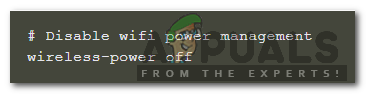
Disabling Wifi Power Management
After disabling wifi power management reboot the Raspberry Pi by using the command mentioned above and enjoy the latest tracks!
How to Fix “Printer is in an error state” Issue?
- Recognizing the importance of a printer’s duty cycle is crucial for choosing a device that matches your print volume needs. Staying within this limit ensures the printer operates efficiently and prolongs its lifespan, minimizing the risk of maintenance issues.
- Proper humidity, temperature, and cleanliness management can significantly enhance printer performance and maintain its duty cycle, preventing unnecessary wear.
- Enhancing a printer with upgrades like additional memory or better mechanical parts can improve its workload handling and extend its practical duty cycle, boosting overall durability and efficiency.
When choosing a new printer, you might come across the term “ duty cycle ” in the specifications. This guide will explain what a duty cycle is, why it matters, and how it can help you choose the right printer. We’ll keep things simple so you can easily understand how to use this information when shopping for a printer.
- Printer Duty Cycle: What It Means and Why It Matters?
- Why the Duty Cycle Is Key to Choosing the Right Printer?
- Duty Cycle vs. Recommended Monthly Print Volume: What’s the Difference?
- What Happens If You Ignore Printer Duty Cycle Recommendations? ↪ Real-World Scenarios: Why Exceeding the Duty Cycle Can Cost You
Printer Duty Cycle: What It Means and Why It Matters?

What is the meaning of Printer Duty Cycle?
The printer duty cycle represents the upper limit of a printer’s capacity—how many pages it can reliably process in a month before the risk of wear or malfunction increases. This figure is crucial for understanding printer performance limits and ensuring that your chosen printer can handle the expected work volume.
Manufacturers determine a printer’s duty cycle through stress testing, where the printer is pushed to its limit to identify how many pages it can produce each month before malfunctioning. These tests help set a reliable performance gateway for users.
A printer’s duty cycle is like a car’s speedometer—you wouldn’t drive a car at top speed all the time, and you shouldn’t push a printer to its maximum duty cycle. Doing so can lead to quicker wear and tear, more frequent maintenance, and a shorter lifespan.
If you’re unsure whether to choose an inkjet or laser printer, this detailed guide compares both options to help you make an informed decision.
Why the Duty Cycle Is Key to Choosing the Right Printer?

The Importance of Duty Cycle in printer selection
Knowing the duty cycle is essential when choosing a printer, as it determines how well the device can handle your monthly print volume without excessive wear or maintenance.
Here is why the duty cycle matters in printer selection:
- Fit for purpose: Selecting a printer with a suitable duty cycle ensures it can handle your monthly printing volume efficiently, reducing stress on its components.
- Longer lifespan and better performance: Staying within the duty cycle ensures optimal print quality and speed while prolonging the printer’s life, avoiding frequent breakdowns.
- Cost efficiency and reduced downtime: Operating within the duty cycle minimizes the need for repairs and reduces operational disruptions, managing long-term costs.
Duty Cycle vs. Recommended Monthly Print Volume: What’s the Difference?

Duty Cycle vs. recommended monthly print volume
The recommended monthly print volume is the optimal number of pages a printer should handle each month for the best performance and longevity. Unlike the maximum capacity indicated by the duty cycle, this number guides regular usage, ensuring the printer operates efficiently without excessive wear.
If your print volume regularly exceeds the recommended amount but stays within the duty cycle, the printer may operate safely in the short term, but it could still experience accelerated wear and reduced lifespan over time.
In such cases, consider upgrading to a higher-capacity printer or spreading print jobs across multiple devices to ensure long-term performance.
Here are the differences between the duty cycle and recommended monthly print volume:
- Duty cycle: Represents the maximum number of pages a printer can handle in a month without breaking down. It assesses the printer’s upper limit.
- Recommended monthly print volume: Suggests a practical, workable number of pages to print each month to keep the printer in good condition over its lifespan.
What Happens If You Ignore Printer Duty Cycle Recommendations?

Consequences of ignoring Duty Cycle recommendations |AndranikHakobyan via Canva
Ignoring the duty cycle limits poses more severe risks than exceeding the recommended monthly print volume, leading to serious long-term consequences.
While exceeding the recommended volume occasionally may result in additional wear and tear, consistently exceeding the duty cycle can lead to frequent breakdowns, reduced performance, and a shortened lifespan.
Ignoring duty cycle limits leads to frequent breakdowns, reduced performance, and increased maintenance, ultimately shortening the printer’s lifespan and causing more frequent operational downtime and higher repair costs. Long-term, pushing a printer beyond its limits leads to greater financial burdens due to premature replacements and inefficiencies.
↪ Real-World Scenarios: Why Exceeding the Duty Cycle Can Cost You
For example, in a busy law firm, overlooking duty cycle limits during a high-stakes period could cause a printer breakdown just before a critical deadline, delaying crucial legal filings and ultimately compromising client service.
For small businesses, consistently exceeding a printer’s duty cycle can lead to costly emergency repairs or premature equipment replacements, straining financial resources.
