Doing what it does best, Google has chosen to rebrand one of its services. We may have all seen this coming a mile away, but the search engine giant is getting ready to rebrand Bard as Gemini across all of its devices and services. This will effectively make Bard obsolete in the future.
In last year’s Pixel 8 event , Google spent a lot of time discussing its plans to consolidate its AI assistant and all of its features into one service that improves everything. And then word got out that Assistant with Bard was officially going through. The signs are starting to point to Gemini as the one thing that will completely replace Bard.
Google is rebranding Bard, according to a new report. The website states, “ Bard is now Gemini. ” This change is being noticed on both mobile devices and the web version, which indicates that Google is seriously considering this, and it will be implemented soon. Also, we need to remember that this trend could lead Bard Advanced to become Gemini Advanced , so that’s something to think about when we plan for the future.
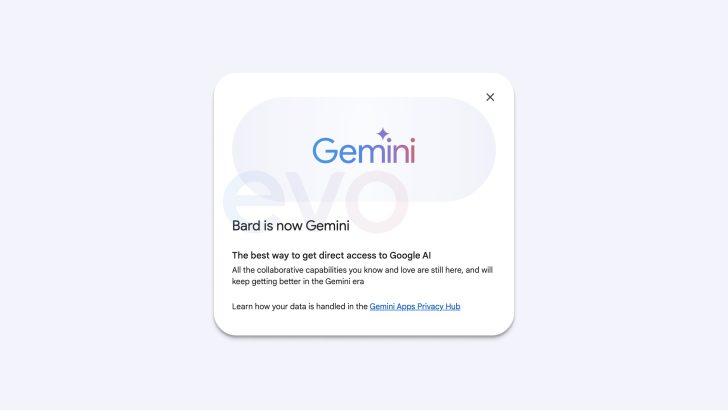
Google Bard Website
Google’s History of Rebranding Services
The rebranding of Bard is unfortunate. This is just another example of Google’s tendency to rebrand or discontinue previously successful products and services. Even though it’s not as terrible as Twitter becoming X , many of us speculated about it because of Google’s past.
Remember that the update isn’t live just yet and that Google will need some time to overhaul it entirely. The way the business is run, it’s possible that we won’t even receive an official explanation for why this change has occurred. A possible explanation that comes to mind is that Google is reluctant to have a multitude of AI-related products as it could lead to consumer confusion. On the other hand, Gemini and Lumiere both exist, so the search engine giant could eliminate one of them.
For people, who have used Google for as long as anyone can remember, watching the gradual demise and rebranding of Google services becomes incomprehensible after a while. It seems like something is still lacking, even though the company is extremely successful and well-known. I believe Google made a mistake by proceeding with the rebranding because it has a significant influence on the brand’s identity, whether it’s Bard or Gemini.
How to Fix “Printer is in an error state” Issue?
OpenAI has just announced the third iteration of its generative AI tool, DALL-E 3 , directly built into ChatGPT . The upgraded version offers better image recreation, more accurate results, content filtering and the power of ChatGPT.
DALL-E 3 Announced With ChatGPT as the Intermediary
DALL-E 3 aims at a few key points that the majority of image generations lack. It allows you to transform your ideas into a visual form at the click of a button. DALL-E is trained off data publicly available on the Internet. It makes use of a diffusion model to convert input text to an image.
Previously, users had to learn something known as ‘ Prompt Engineering ‘. You’d spend valuable time writing out your description. Whereas, the model at times had a tendency to ignore a few select and important words.
The real constraint comes when users have to define their visual perceptions and ideas in a written format. This language gap is bridged with the introduction of ChatGPT . Aditya Ramesh , head of the DALL-E team remarks:
“You won’t really have to worry about fussing around with really long prompts. Instead, you can just interact with ChatGPT as if you were talking to a coworker” Aditya Ramesh
With DALL-E 3, users can simply ask ChatGPT to come up with suitable prompts. Since DALL-E works better with lengthier paragraphs, the integration of ChatGPT provides a significant advantage to DALL-E 3 over its competitors.
It is very similar to having a real artist sitting right beside you, brush and paint in hand, ready for your prompts. The image below showcases that the users enter a few keywords, highlighted in white, and ChatGPT automatically generates an entire layout for DALL-E 3 to use. It is a simple yet effective solution.
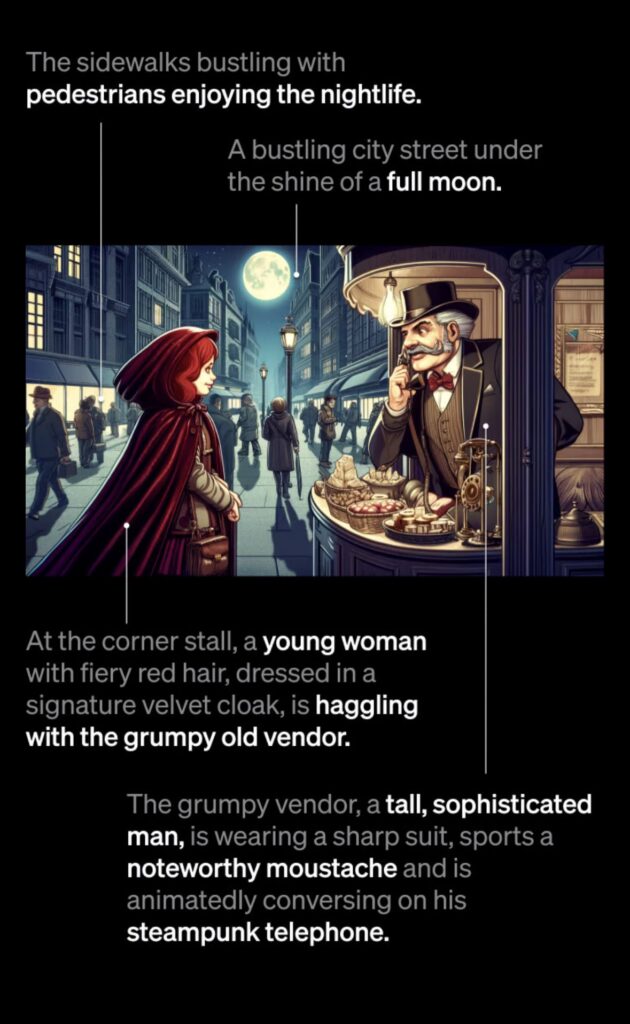
ChatGPT’s Integration into DALL-E 3 | OpenAI via Linus (Twitter)
Visual Differences
We have a few images to showcase the bells and whistles of DALL-E 3. To be blunt, the difference is as clear as day and night. Have a look for yourself.
The image recreated by DALL-E 2 looks no more than an oil painting, with minor details. DALL-E 3 takes things one step further by hosting the same basketball game in space? Well, that’s what it seems like. No model is perfect, however, there is a huge quality variance between the two with the latter in lead.
- DALL-E 2 Generated Image | OpenAI via Linus
- DALL-E 3 Generated Image | OpenAI via Linus
More examples show that DALL-E 3’s visualisations are almost hyperrealistic. Everything from the high-quality textures, the reflections, the illumination and whatnot is achieving near-perfect levels of quality. What’s scary is I would find it hard to tell if these images were AI-generated or not, had I been a part of some blind test.
- DALL-E 3 Image Generation | OpenAI via Linus
- DALL-E 3 Image Generation | OpenAI via Linus
- DALL-E 3 Image Generation | OpenAI via Linus
- DALL-E 3 Image Generation | OpenAI via Linus
Safety Policy
Moving over to the safety side of things, OpenAI touts that DALL-E 3 will follow strict guidelines that curb lewd, hateful, or violent content. The model is trained as such that it ignores prompts containing certain terms. This also extends to the image recreation of public celebrities.
Sandhini Agarwal , policy researcher at OpenAI states that DALL-E underwent even more rigorous red teaming . A group of researchers tried their best to push DALL-E 3 to its limits, in regards to the content it would generate. Requests involving explicit content or terms would go through a classifier and end up being rejected.
There are a plethora of image generators that create content with no holds barred, available online. However, DALL-E 3 caters to the general public and wants to develop a safe and family-friendly environment.
Availability
DALL-E 3 will be available for ChatGPT Plus and ChatGPT Enterprise users starting in October . The API will go live sometime during the Fall , however, there’s no word on a free public version, as of now.
Image Sources: OpenAI (via Linus )
