After generative AI gained some popularity a little over a year ago, Google has announced Chrome browser updates that utilize it. Meta , OpenAI (supported by Microsoft ), and Google are just a few of the major companies in the artificial intelligence industry at the moment. Along with the launch of an AI-backed writing helper for casual users, the industry is in dire need of massive amounts of computer capacity in order to bring machine learning to the everyday consumer.
Earlier today, Google’s VP Parisa Tabriz wrote a blog post revealing the set of recent AI-based Chrome browser enhancements. According to the head of Chrome, the new features are now in an “ experimental ” phase, so only casual and regular users will have access to them. Things like customizing the browser with themes and backgrounds and controlling the browser’s tabs were announced.
Within the most recent round of updates, Google has introduced a writing assistant for the Chrome browser, and the company defines its AI efforts as addressing “ real user pain points ” through the usage of the technology. This update, like the other two, was announced today, but it won’t be accessible until next month.

Google’s Writing Assistant
As competition for artificial intelligence (AI) grows, the software giant has released its most recent batch of updates. Microsoft has upgraded its Edge browser with an AI logo thanks to its relationship with OpenAI. A few times after ChatGPT was released to the public, Microsoft also made Bing “ A.I. powered. “
The new features can be enabled for Chrome users in the US after today’s announcement by going to the browser’s Settings menu and selecting them. Companies with large user bases and substantial financial resources, like Google and Microsoft , are in a prime position to launch and test new products. On the other hand, new players in the industry need to focus on user acquisition before thinking about how to monetize their platform effectively.
Google’s most recent statement appears to be heading in the same direction, given the new capabilities will first be accessible solely to users in the United States. Artificial intelligence will soon allow users to organize their Chrome tabs by website class and apply new themes at will.
The writing assistance, according to Google, will be released with Chrome in February. Many people have begun to trust artificial intelligence programs like ChatGPT with not only their schoolwork and test scores but also their writing. The use of artificial intelligence (AI) tools, such as writing prompts and email generators, has been on the rise, and Google’s writing assistant aims to provide users with this capability straight from their browsers.
Google claims that users will be able to access the writing assistance with a right-click and that they will only need to type a few words before the AI takes over. Parameters allow artificial intelligence models to align their outputs with the inferences established during training, which is usually done over massive amounts of data.
How to Fix “Printer is in an error state” Issue?
OpenAI has just announced the third iteration of its generative AI tool, DALL-E 3 , directly built into ChatGPT . The upgraded version offers better image recreation, more accurate results, content filtering and the power of ChatGPT.
DALL-E 3 Announced With ChatGPT as the Intermediary
DALL-E 3 aims at a few key points that the majority of image generations lack. It allows you to transform your ideas into a visual form at the click of a button. DALL-E is trained off data publicly available on the Internet. It makes use of a diffusion model to convert input text to an image.
Previously, users had to learn something known as ‘ Prompt Engineering ‘. You’d spend valuable time writing out your description. Whereas, the model at times had a tendency to ignore a few select and important words.
The real constraint comes when users have to define their visual perceptions and ideas in a written format. This language gap is bridged with the introduction of ChatGPT . Aditya Ramesh , head of the DALL-E team remarks:
“You won’t really have to worry about fussing around with really long prompts. Instead, you can just interact with ChatGPT as if you were talking to a coworker” Aditya Ramesh
With DALL-E 3, users can simply ask ChatGPT to come up with suitable prompts. Since DALL-E works better with lengthier paragraphs, the integration of ChatGPT provides a significant advantage to DALL-E 3 over its competitors.
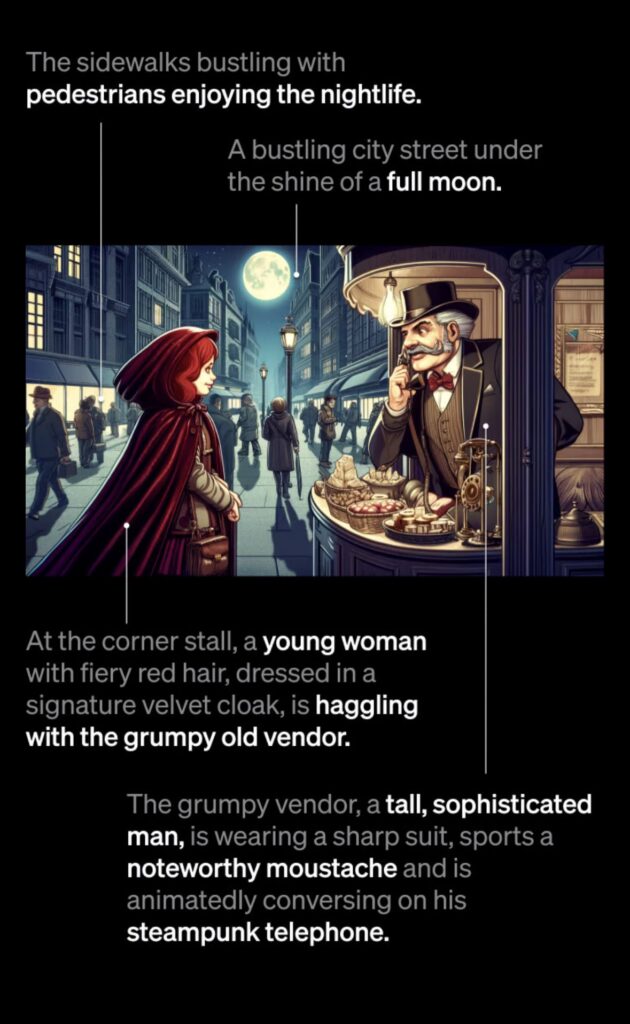
It is very similar to having a real artist sitting right beside you, brush and paint in hand, ready for your prompts. The image below showcases that the users enter a few keywords, highlighted in white, and ChatGPT automatically generates an entire layout for DALL-E 3 to use. It is a simple yet effective solution.
ChatGPT’s Integration into DALL-E 3 | OpenAI via Linus (Twitter)
Visual Differences
We have a few images to showcase the bells and whistles of DALL-E 3. To be blunt, the difference is as clear as day and night. Have a look for yourself.
The image recreated by DALL-E 2 looks no more than an oil painting, with minor details. DALL-E 3 takes things one step further by hosting the same basketball game in space? Well, that’s what it seems like. No model is perfect, however, there is a huge quality variance between the two with the latter in lead.
- DALL-E 2 Generated Image | OpenAI via Linus
- DALL-E 3 Generated Image | OpenAI via Linus
More examples show that DALL-E 3’s visualisations are almost hyperrealistic. Everything from the high-quality textures, the reflections, the illumination and whatnot is achieving near-perfect levels of quality. What’s scary is I would find it hard to tell if these images were AI-generated or not, had I been a part of some blind test.
- DALL-E 3 Image Generation | OpenAI via Linus
- DALL-E 3 Image Generation | OpenAI via Linus
- DALL-E 3 Image Generation | OpenAI via Linus
- DALL-E 3 Image Generation | OpenAI via Linus
Safety Policy
Moving over to the safety side of things, OpenAI touts that DALL-E 3 will follow strict guidelines that curb lewd, hateful, or violent content. The model is trained as such that it ignores prompts containing certain terms. This also extends to the image recreation of public celebrities.
Sandhini Agarwal , policy researcher at OpenAI states that DALL-E underwent even more rigorous red teaming . A group of researchers tried their best to push DALL-E 3 to its limits, in regards to the content it would generate. Requests involving explicit content or terms would go through a classifier and end up being rejected.
There are a plethora of image generators that create content with no holds barred, available online. However, DALL-E 3 caters to the general public and wants to develop a safe and family-friendly environment.
Availability
DALL-E 3 will be available for ChatGPT Plus and ChatGPT Enterprise users starting in October . The API will go live sometime during the Fall , however, there’s no word on a free public version, as of now.
Image Sources: OpenAI (via Linus )
