YouTube-dl shows the ‘unable to extract uploader id’ error when it fails to analyze the provided video URL. Due to this, the uploader ID goes missing, which is essential to finding and downloading a particular video.
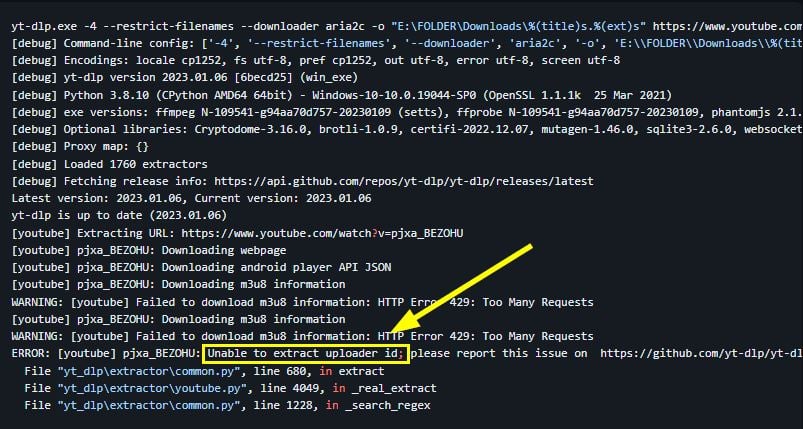
The reason for this error showing up can be that you’ve got an outdated version of youtube-dl. It doesn’t matter which operating system you’re using; make sure the youtube-dl version is 2021.12.17.
You can check the version by running the following command in the command prompt:
$ youtube-dl -version
If it’s an older version, make sure to upgrade it. I’ll mention the steps for that below.
Apart from this, there are three more ways to fix this error, and each of them requires you to execute some commands.
1. Update youtube-dl
As I mentioned above, updating youtube-dl is necessary to make it function properly. The latest version is 2021.12.17, and no new ‘official’ update has been released after that. Though there’s a patched v2023.02.17 as well.
Having said that, below are the commands to update youtube-dl on different platforms:
For Windows: You need to go to the location where youtube-dl was downloaded. Afterward, type cmd on the location bar and execute the following command.
youtube-dl -U

For macOS:
brew upgrade youtube-dl
For Self-Updating
youtube-dl --update
Using Python
pip install -U youtube-dl
2. Reinstall youtube-dl
If the update doesn’t work , then reinstall the youtube-dl download manager altogether. Again, I will list the commands and steps for each operating system. You don’t need any commands on Windows, but they will do on Linux and Mac.
On Windows
- Delete the youtube-dl.exe file and empty the recycle bin.
- Now go to the youtube-dl download page .
- Click on youtube-dl.exe to start the download.

- Copy the file to any folder you want or create a new one.
On macOS
- Find the path where youtube-dl is installed and run the following command in Terminal.app: $rm -rf /usr/local/bin/youtube-dl
- Replace /usr/local/bin/youtube-dl with your path location.
- Now make sure you have Homebrew installed on Mac .
- If not, use this command to install it: /bin/bash -c “$(curl -fsSL https://raw.githubusercontent.com/Homebrew/install/HEAD/install.sh)%22 "
- Otherwise, download the MacPorts .
- To install youtube-dl with brew , execute the following command: sudo brew install youtube-dl
- To install youtube-dl with MacPorts , execute the following command: sudo port install youtube-dl
On Linux
- Run the command below to uninstall youtube-dl : $ sudo apt remove youtube-dl
- Run the command below to install youtube-dl again : $ sudo apt install youtube-dl
Now try and download some videos and see if the ‘unable to extract uploader id’ error shows up or not.
3. Install the Master Branch of youtube-dl
Installing the master branch (youtube-dlp) and importing it as youtube-dl has worked for many users. This method will be completed by using just two commands, and the uploader id problem will be gone. But before that, make sure you have Python on your system.
Here’s what you need to do:
- Reinstall the library from Github by executing the following command: python3 -m pip install –force-reinstall https://github.com/yt-dlp/yt-dlp/archive/master.tar.gz
- Once the download completes, import the library as follows: import yt_dlp as youtube_dl
- You can also download a patched version of this library with the following command: python3 -m pip install yt-dlp==2023.02.17.334
4. Install and Use yt-dlp
yt-dlp is a fork of youtube-dl and is based on youtube-dlc which is now inactive. With yt-dlp, you get the combined features of youtube-dl and dlc. There are many new features in it, including support for clips, stories, filtered search, and more.
So, if youtube-dl keeps showing the ‘unable to extract uploader id’ error, it’s a good idea to start using yt-dlp.
Here’s how you can install it on different OSes:
- Go to the GitHub page of yt-dlp .
- Go to the Release Files section.

- Click on the file you want to download on your OS and it will start downloading.
Alternatively, you can use commands instead of these steps.
For UNIX-like OSes (Linux, BSD, MacOS)
Use either of the three ways:
sudo curl -L https://github.com/yt-dlp/yt-dlp/releases/latest/download/yt-dlp -o /usr/local/bin/yt-dlp
sudo chmod a+rx /usr/local/bin/yt-dlp # Make executable
sudo wget https://github.com/yt-dlp/yt-dlp/releases/latest/download/yt-dlp -O /usr/local/bin/yt-dlp
sudo chmod a+rx /usr/local/bin/yt-dlp # Make executable
sudo aria2c https://github.com/yt-dlp/yt-dlp/releases/latest/download/yt-dlp --dir /usr/local/bin -o yt-dlp
sudo chmod a+rx /usr/local/bin/yt-dlp # Make executable
Using pip (Python)
python3 -m pip install -U yt-dlp
To install without optional dependencies :
python3 -m pip install --no-deps -U yt-dlp
Using Homebrew
brew install yt-dlp
Using Pacman
sudo pacman -Syu yt-dlp
With APT
sudo add-apt-repository ppa:tomtomtom/yt-dlp # Add ppa repo to apt
sudo apt update # Update package list
sudo apt install yt-dlp # Install yt-dlp
With MacPorts
sudo port install yt-dlp
How to Fix “Printer is in an error state” Issue?
The error “ WinRAR Error: Next Volume Is Required ” usually appears when you’re extracting a multi-part RAR archive and WinRAR can’t find (or can’t correctly identify) the next file in the sequence . This often happens when a volume is missing , stored in a different folder , or renamed in a way that breaks the archive’s expected order .

In this guide, we’ll go over the most reliable fixes confirmed by affected users, along with what each method is doing behind the scenes so you can choose the right one for your situation.
Important: To extract multi-volume archives, you should always start extraction from the first file in the set. This is usually file.part1.rar , or (in older sets) the main .rar file that comes before .r01 , .r02 , and so on.
1. Download and Place the Missing RAR File
WinRAR needs all parts of a multi-volume archive to complete extraction. This error usually appears when one of the volumes in a set like .part2.rar , .r01 , .r02 , .001 , and similar naming formats is missing . Downloading the missing volume and placing it in the same folder as the other parts allows WinRAR to continue extracting normally .
- Look at the error message or review the list of archive parts in the folder.
- Identify which volume is missing (for example, part2.rar , .r02 , .001 , etc.).
- Go back to the website or source where you downloaded the archive.
- Locate and download the exact missing file using the same naming format as the others.
- Make sure the new file name matches the pattern of the rest. Example: If you have file.part1.rar and file.part3.rar , the missing one must be file.part2.rar .
- Move the downloaded missing volume into the same folder as the other archive parts.
- Confirm that all parts are in a single folder before extracting.
- Right-click the first file in the series (usually part1 or the main .rar file) and select Extract Here or Extract to Folder .
- WinRAR should now detect all volumes and continue extraction normally .
2. Manually Browse & Select the Next Volume
Use this method only if the next volume already exists , but WinRAR is failing to detect it automatically. This can happen due to incorrect naming , the file being in a different location , or a temporary file access issue. Manually browsing helps WinRAR locate the correct volume and resume extraction without interruption .
- Right-click the first file in the series (usually .rar or part1.rar ) and select Extract Here or Extract to Folder .
- When WinRAR cannot find the next volume, it will show the “ Next Volume Is Required ” message.
- A small window will appear, allowing you to manually select the next volume .
- Use the file explorer window to locate the folder where the other archive parts are saved.
- Select the next part based on the naming order (example: select file.part2.rar after file.part1.rar ).
- Make sure the selected file matches the naming format of the archive (no extra characters like (1) and no mismatched numbering).
- WinRAR will resume extraction using the selected volume .
- If additional volumes are missing or stored separately, WinRAR may prompt you again. Repeat the same process until extraction completes.
3. Rename the RAR files in Order
WinRAR relies on a proper naming sequence (such as file.part1.rar , file.part2.rar , file.part3.rar ) to extract multi-volume archives. If a file is named incorrectly, contains extra characters, or is out of order, WinRAR may fail to locate the next volume and show this error. Renaming the files correctly helps WinRAR follow the sequence and extract the archive without interruptions .
Note: Renaming only changes the file name , not the file contents. The goal is to restore the correct sequence so WinRAR can detect the next volume.
- Go to the folder where all the RAR files are saved.
- Make sure all parts of the archive are present and stored in the same folder .
- Check how the parts are currently named . Common patterns include:
file.part1.rar, file.part2.rar, file.part3.rar
file.rar, file.r01, file.r02, file.r03
- Look for files that don’t match the expected numbering pattern (for example, file.part01.rar , file.part1(1).rar , or unrelated names).
- Rename each file so it follows the same order without extra characters or mismatched numbering. Example:
Incorrect: file.part1.rar, file.part3.rar, file.part2(1).rar
Correct: file.part1.rar, file.part2.rar, file.part3.rar
- Make sure the text before the number is exactly the same for all files.
- Only the last part number should change.
- Right-click the first file in the series (usually part1.rar or the main .rar file) and select Extract Here .
- WinRAR should now recognize the sequence and continue extraction normally .
If you still get the same prompt: the archive set is likely incomplete (a part was never downloaded or was removed), or one of the volumes is corrupt and must be re-downloaded from the original source.
