The Samsung Data Migration tool may fail to clone a hard disk due to the access restrictions implemented by UAC or BitLocker. Moreover, bad sectors of the hard disk or presence of essential OS files (like paging or hibernation files) on the drive may also cause the error under discussion.
The affected user encounters the error when he tries to clone a hard disk by using the Samsung Data Migration application. Nearly all types of disks (SSD and HDD) with different storage capacity suffered from the problem. The issue is reported to occur on nearly all the makes and models of the PC.
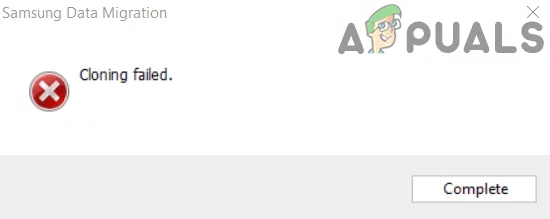
Samsung Data Migration Cloning Failed
Before moving on with the solutions, make sure you are using the latest version of the Samsung Data Migration program. Moreover, try to use SATA cable (not SATA to USB) to connect the drives to your system.
Solution 1: Launch the Samsung Data Migration with Administrator Privileges
Microsoft has enhanced the security of essential system resources by the use of UAC. You may encounter the error at hand if the migration application does not have the required rights to complete the operations required to perform all the tasks. In this context, launching the data migration tool with administrator rights may solve the problem.
- Right-click on the Samsung Data Migration application and then in the menu shown, click on Run as Administrator . Run the Samsung Data Migration as Administrator
- Then check if the cloning issue is resolved.
- If not, then once again, right-click on the Data Migration tool and then in the menu shown, click on Troubleshoot Compatibility . Click on Troubleshoot Compatibility of the Samsung Data Migration Tool
- Now apply the proposed solution (to run the program in an older version of the Windows) and then check if the cloning issue is resolved.
Solution 2: Disable BitLocker for the Source Drive
You may fail to clone a partition if the drive is encrypted with the BitLocker as this cannot be read by the cloning application. In this scenario, removing the BitLocker encryption from the drive may solve the cloning problem.
- Type BitLocker in the Windows Search bar (on the Taskbar of your system) and then in the list of results, click on Manager BitLocker . Manage BitLocker
- Now, in the BitLocker window, disable BitLocker for every partition of the source drive. Turn Off BitLocker
- Wait for the completion of the decrypt process.
- Then check if you can complete the cloning process.
Solution 3: Run the Check Disk Command on the Source Drive
Samsung Data Migration tool is not good in handling the bad sectors of your hard disk and the cloning may fail to complete if your hard disk has bad sectors on it. In this context, running the check disk command to clear the issue of bad sectors on your hard disk, and thus the cloning issue may get solved.
- Run the chkdsk C:/r command, where C is the problematic partition. You can also use another application like SeaTools to check for the bad sectors.
- Wait for the completion of the process (this might take a while). Run ChkDsk /r Command
- Repeat the process for all the partition of the source drive.
- Then check if you can clone the disk.
Solution 4: Disabling modules and Defragmenting the Drive
You may encounter the current cloning error if any system-related processes (like paging file or system restore points) are limiting access to certain areas of the drive. In this scenario, disabling the paging file and the system restore module may solve the problem.
- Scan your source hard disk for any viruses etc . You can also use any of the online tools like ESET Online Scanner.
- Disable the paging file of all the partitions on the source drive.
- Then check if the cloning issue is resolved.
- If not, type Control Panel in the Windows Search box and then in the results list, click on Control Panel . Open Control Panel
- Now click on System and Security and then click on System . Open System and Security
- Then in the left pane of the window, click on System Protection . Open System Protection
- Now select the source drive and then click on Configure . Open Configure for the Source Drive
- Then select the option of Disable System Protection .
- Now click on the Delete button to delete all the restore points of the drive. Disable System Protection and Delete the Restore Point on the Drive
- Now click on the Apply and then click on the OK button.
- Now check if the cloning issue is resolved.
- If not, type Command Prompt in the Windows Search box and then in the list of results, right-click on the Command Prompt and then click on Run as Administrator . Open Command Prompt as Administrator
- Click Yes if a UAC prompt appears.
- Now type the following command in the Command Prompt and then hit the Enter key: powercfg.exe /hibernate off
- Then exit the Command Prompt and restart your system.
- Upon restart, type Explorer in the Windows Search bar and then in the list of the results, right-click on Explorer and then click on Run as Administrator . Open Explorer as Administrator
- Then navigate to the following path (your system drive): %SYSTEMDRIVE%
- Now delete the hiberfil.sys file. Delete hiberfil.sys File
- If you cannot view the hiberfil.sys file, then you may have to show hidden files and system files to view the file. Show Hidden Files and Protected System Files
- Now check if the cloning issue is resolved.
- If not, perform a disk clean up of all the partitions and check if you can clone the disk.
- If not, then type Defragment in the Windows Search box and then click on Defragment and Optimize Drives . Open Defragment and Optimize Drives
- Now select the source drive and then click on the Optimize button. Optimize and Defragment Your Hard Drive
- Then wait for the completion of the defragment process and hopefully, you can clone the drive.
If nothing has helped you so far, try to reduce the partition size of your source drive (to match the destination size). If even then the problem persists, then try to use another cloning software to clone the drive. If the issue is still there, then you may have to use a bootable CD like Acronis boot CD to copy the drive. If none of the solutions worked, then you may have to reinstall the OS and manually copy the data.
How to Fix “Printer is in an error state” Issue?
The error “ WinRAR Error: Next Volume Is Required ” usually appears when you’re extracting a multi-part RAR archive and WinRAR can’t find (or can’t correctly identify) the next file in the sequence . This often happens when a volume is missing , stored in a different folder , or renamed in a way that breaks the archive’s expected order .

In this guide, we’ll go over the most reliable fixes confirmed by affected users, along with what each method is doing behind the scenes so you can choose the right one for your situation.
Important: To extract multi-volume archives, you should always start extraction from the first file in the set. This is usually file.part1.rar , or (in older sets) the main .rar file that comes before .r01 , .r02 , and so on.
1. Download and Place the Missing RAR File
WinRAR needs all parts of a multi-volume archive to complete extraction. This error usually appears when one of the volumes in a set like .part2.rar , .r01 , .r02 , .001 , and similar naming formats is missing . Downloading the missing volume and placing it in the same folder as the other parts allows WinRAR to continue extracting normally .
- Look at the error message or review the list of archive parts in the folder.
- Identify which volume is missing (for example, part2.rar , .r02 , .001 , etc.).
- Go back to the website or source where you downloaded the archive.
- Locate and download the exact missing file using the same naming format as the others.
- Make sure the new file name matches the pattern of the rest. Example: If you have file.part1.rar and file.part3.rar , the missing one must be file.part2.rar .
- Move the downloaded missing volume into the same folder as the other archive parts.
- Confirm that all parts are in a single folder before extracting.
- Right-click the first file in the series (usually part1 or the main .rar file) and select Extract Here or Extract to Folder .
- WinRAR should now detect all volumes and continue extraction normally .
2. Manually Browse & Select the Next Volume
Use this method only if the next volume already exists , but WinRAR is failing to detect it automatically. This can happen due to incorrect naming , the file being in a different location , or a temporary file access issue. Manually browsing helps WinRAR locate the correct volume and resume extraction without interruption .
- Right-click the first file in the series (usually .rar or part1.rar ) and select Extract Here or Extract to Folder .
- When WinRAR cannot find the next volume, it will show the “ Next Volume Is Required ” message.
- A small window will appear, allowing you to manually select the next volume .
- Use the file explorer window to locate the folder where the other archive parts are saved.
- Select the next part based on the naming order (example: select file.part2.rar after file.part1.rar ).
- Make sure the selected file matches the naming format of the archive (no extra characters like (1) and no mismatched numbering).
- WinRAR will resume extraction using the selected volume .
- If additional volumes are missing or stored separately, WinRAR may prompt you again. Repeat the same process until extraction completes.
3. Rename the RAR files in Order
WinRAR relies on a proper naming sequence (such as file.part1.rar , file.part2.rar , file.part3.rar ) to extract multi-volume archives. If a file is named incorrectly, contains extra characters, or is out of order, WinRAR may fail to locate the next volume and show this error. Renaming the files correctly helps WinRAR follow the sequence and extract the archive without interruptions .
Note: Renaming only changes the file name , not the file contents. The goal is to restore the correct sequence so WinRAR can detect the next volume.
- Go to the folder where all the RAR files are saved.
- Make sure all parts of the archive are present and stored in the same folder .
- Check how the parts are currently named . Common patterns include:
file.part1.rar, file.part2.rar, file.part3.rar
file.rar, file.r01, file.r02, file.r03
- Look for files that don’t match the expected numbering pattern (for example, file.part01.rar , file.part1(1).rar , or unrelated names).
- Rename each file so it follows the same order without extra characters or mismatched numbering. Example:
Incorrect: file.part1.rar, file.part3.rar, file.part2(1).rar
Correct: file.part1.rar, file.part2.rar, file.part3.rar
- Make sure the text before the number is exactly the same for all files.
- Only the last part number should change.
- Right-click the first file in the series (usually part1.rar or the main .rar file) and select Extract Here .
- WinRAR should now recognize the sequence and continue extraction normally .
If you still get the same prompt: the archive set is likely incomplete (a part was never downloaded or was removed), or one of the volumes is corrupt and must be re-downloaded from the original source.
